Slime Mold Intelligence: Physics, Biology, or Both?
Slime Mold Intelligence: Physics, Biology, or Both?
Slime molds can navigate complex environments, respond to changing conditions, and build efficient networks without a brain or nervous system. Their behavior can look remarkably intelligent. Laboratory experiments and popular science coverage often describe them as organisms that solve problems, make decisions, or remember past events.
This raises a central question: does slime mold behavior require intelligence, or can physics and biology explain it through self-organization?
The answer depends partly on how intelligence is defined. Slime molds clearly produce organized, adaptive responses. They interact with their surroundings, alter their growth, and sometimes arrive at solutions that resemble planned designs. These results do not automatically prove consciousness, deliberate reasoning, or a mind comparable to an animal’s.
Much of what looks like slime mold intelligence may emerge from physical processes, including local chemical signals, fluid movement, growth, feedback, and environmental constraints. This explanation does not make the organism’s behavior trivial. Instead, it shows how complex outcomes can arise without a central controller.
What Is a Slime Mold?
A Simple Organism With Complex Behavior
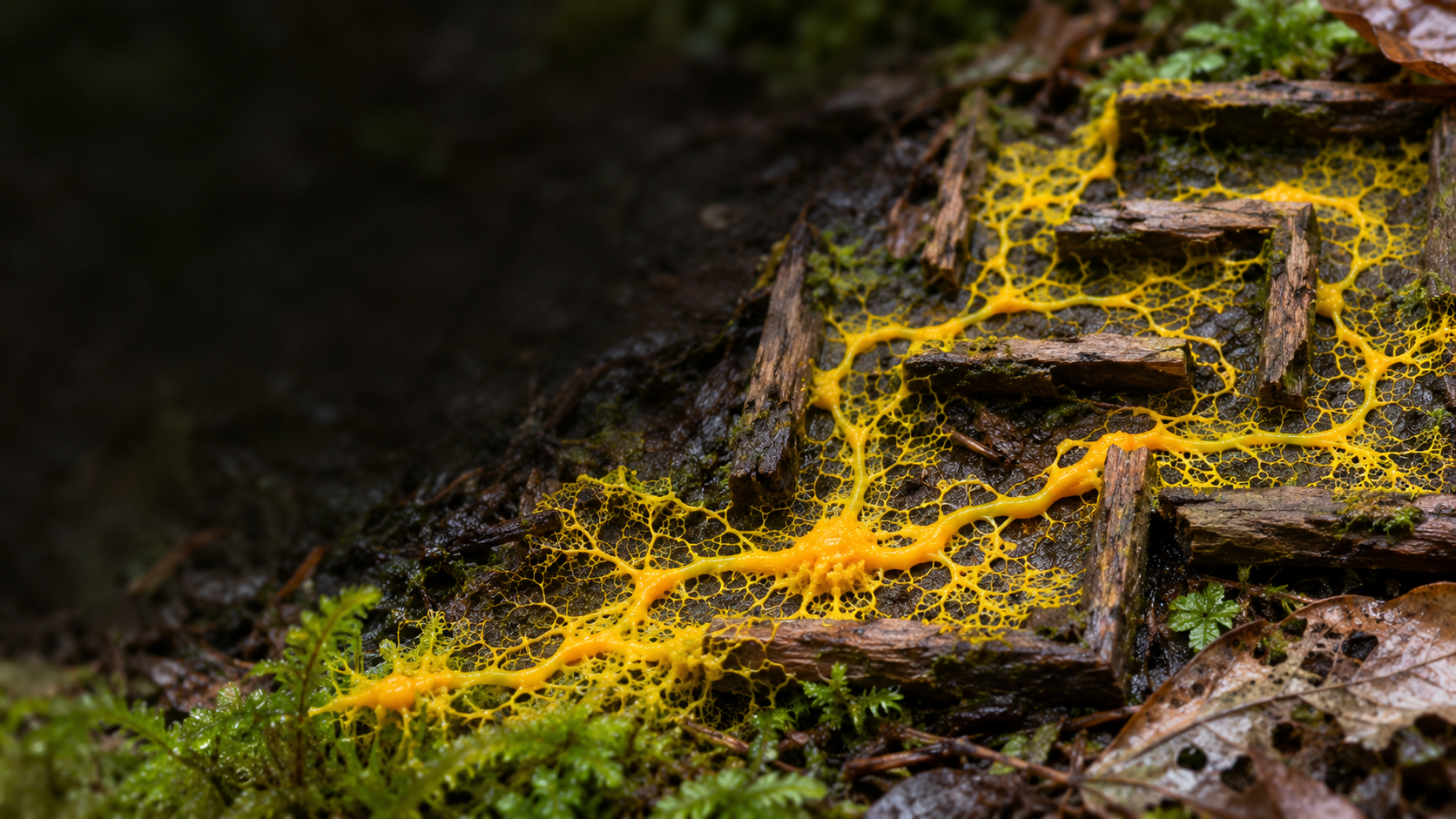
Slime molds can spread through an environment, respond to resources, and reorganize their networks. Some species form flowing, interconnected structures rather than bodies with familiar organs. They have no brain, centralized nervous system, or conventional command center.
“Simple,” however, does not mean inactive. A slime mold can respond flexibly to its environment. Its structure may change when it encounters food, barriers, moisture differences, light, or other conditions. Parts of its network can strengthen, weaken, extend, or disappear as circumstances change.
This creates a difficult classification problem. A system without neurons can still detect differences, transmit signals, alter its shape, and produce coordinated behavior. The absence of a brain does not eliminate complexity. It means that coordination must occur through different mechanisms.
Why Their Behavior Attracts the Word “Intelligence”
People often judge intelligence by outcomes. If an organism finds an efficient route, avoids an obstacle, or adjusts its behavior after conditions change, observers may describe the result as problem-solving.
Slime molds appear to:
- Find routes through complex spaces
- Respond to obstacles
- Adjust their growth patterns
- Maintain useful connections
- Exploit favorable resources
- Reduce or abandon less useful pathways
These behaviors resemble planning when viewed from the outside. A final network can look like a designed solution even though no central agent appears to have designed it.
The important distinction is between intelligent-looking behavior and evidence of an intelligent mind. An efficient result does not, by itself, prove conscious planning. The same caution applies to many natural systems. Ant colonies coordinate without a manager, crystals form ordered structures without a blueprint, and flocks move as groups without a leader.
The question is not whether slime molds do anything interesting. They do. The question is whether the word “intelligence” accurately describes the mechanism producing those results.
The Core Debate: Intelligence or Physics?
The Case for Calling Slime Mold Behavior Intelligent
Intelligence can be defined broadly as the ability to sense conditions, process information, adapt, and produce effective responses. Under this functional definition, a brain may not be essential.
A slime mold receives environmental information through local interactions. It responds to conditions around different parts of its body. Its network changes as resources and obstacles change. Successful growth can be reinforced while less useful structures weaken. The organism then produces coordinated behavior without a central decision-maker.
This supports the idea of distributed intelligence. No single cell or region needs to direct the entire organism. Instead, many local interactions create a global response. The system behaves as a coordinated whole because its parts influence one another.
This broad definition challenges the assumption that intelligence must resemble human thought. If intelligence means adaptive information processing, slime mold behavior may qualify as a basic or unusual form of intelligence.
The Case Against Overusing the Term “Intelligence”
The opposing concern is that “intelligence” can become too broad. If every adaptive physical response counts as intelligence, the term may lose its ability to distinguish cognition from automatic behavior.
Several claims must be separated:
- A system responds to physical or chemical gradients.
- A system processes environmental information.
- A system represents a problem internally.
- A system makes a decision.
- A system has conscious experiences.
These statements do not mean the same thing. Slime mold behavior may support the first two. It does not automatically establish the others.
Calling a slime mold “intelligent” can also encourage anthropomorphism: the projection of human motives and mental categories onto a different organism. Saying that a slime mold “chooses the best route” may suggest awareness, comparison, and intention that have not been demonstrated.
The debate therefore involves both biology and language. As The Guardian’s discussion of the subject emphasizes, conventional definitions often connect intelligence with brains, language, consciousness, or complex cognition. Expanding the definition may reveal new forms of biological organization, but it may also blur important distinctions. Source 3
Why the Definition Matters
Under a narrow definition, slime molds may not be intelligent. They lack a brain, known mental representations, and established evidence of conscious thought.
Under a functional definition, however, their ability to respond adaptively and reorganize their bodies may qualify as a basic form of intelligence. The disagreement is partly scientific and partly philosophical because researchers must decide which capabilities the word includes.
A useful approach is to treat intelligence as a collection of abilities rather than a single property. Sensing, regulation, adaptation, learning, memory, prediction, planning, and consciousness may not appear together in every organism.
How Physics Can Produce Intelligent-Looking Behavior
Local Rules Can Create Global Order
Self-organization occurs when local interactions produce a coordinated, large-scale pattern. Each part responds to nearby conditions, and those responses accumulate. The whole system develops structure without a central planner.
This process appears throughout nature:
- Flocks form from the movements of individual birds.
- Ant colonies coordinate through local signals.
- Crystals develop ordered patterns from molecular interactions.
- Traffic waves emerge from the movements of individual drivers.
In each case, the global pattern can look organized even though no single component controls the entire system.
Slime mold behavior may follow a similar principle. Local changes in growth, chemical signaling, and material flow can alter the organism’s larger structure. The final network may appear to reflect a plan while actually emerging from repeated local adjustments.
ScienceAlert’s discussion of slime mold intelligence presents this possibility directly: behavior described as cognition may instead arise from physical processes and self-organization. The argument does not show that every aspect of slime mold behavior has been explained, but it warns against assuming that intelligence is necessary whenever behavior produces an efficient outcome. Source 1
Gradients, Flows, and Environmental Signals
Slime mold growth can be influenced by nutrients, moisture, light, chemical signals, and physical barriers. These factors may affect how its body develops.
The process can be described as a feedback system:
- The organism encounters local environmental conditions.
- Those conditions influence growth or internal flow.
- Growth changes the organism’s structure.
- The new structure alters how signals and resources move.
- Those changes affect the next stage of growth.
This cycle does not require conscious deliberation. The organism can respond locally, change its shape, and create new conditions that influence later responses.
That does not mean every behavior has been reduced to a complete physical formula. Biological systems are complex, and several mechanisms may interact. The narrower point is that physical and chemical processes can generate adaptive organization without a central mind.
Feedback Loops and Network Formation
Feedback helps explain why slime mold networks can become efficient-looking.
Useful pathways may be reinforced because they carry resources or support continued growth. Less useful pathways may weaken when they receive fewer resources or signals. Repeated reinforcement and reduction can reshape the network over time.
The system does not need to imagine every possible route. It can filter pathways through ongoing interaction with the environment. A route that remains effective becomes more prominent; a route that performs poorly becomes less important.
This is optimization without foresight. The result may resemble a planned solution, but the process can be based on selection, reinforcement, and physical constraints.
Does Problem-Solving Require a Brain?
Solving a Problem Versus Representing a Problem
A system can produce an effective response to a challenge without representing that challenge mentally.
In a psychological sense, problem-solving may involve understanding a situation, imagining possible solutions, comparing alternatives, and choosing deliberately. In a functional sense, problem-solving simply means that a system responds effectively to a difficult condition.
Slime mold experiments may demonstrate the second type. The organism can navigate constraints and alter its network in ways that solve an environmental task. That does not prove that it understands the task or compares solutions internally.
Researchers should therefore distinguish between functional problem-solving and psychological problem-solving. The first describes an observable outcome. The second makes claims about internal cognition.
Distributed Processing Without a Central Controller
Slime mold behavior may emerge from many local interactions rather than one command center. Local regions can detect changes, modify growth, preserve successful pathways, and remove inefficient structures.
This challenges brain-centered assumptions about intelligence. A system may coordinate behavior through its entire structure instead of storing control in a specialized organ.
Decentralized coordination does not automatically prove cognition. It demonstrates another route to organized behavior. The organism can be adaptive without possessing a miniature version of a human brain.
What Experiments Can and Cannot Show
Laboratory experiments can reveal:
- Behavioral flexibility
- Environmental sensitivity
- Network adaptation
- Repeatable response patterns
- Changes in growth under different conditions
These observations are scientifically valuable. They help researchers identify mechanisms, test physical models, and determine which responses are automatic or flexible.
However, behavior alone cannot establish consciousness, human-like reasoning, intentional planning, or subjective experience. The safest interpretation separates what an experiment directly shows from the broader conclusions drawn from it.
The Problem With Anthropomorphism
When Human Language Helps
Terms such as “memory,” “decision,” and “intelligence” can provide useful shorthand. They help describe complex biological processes in language that non-specialists understand.
For example, saying that a slime mold “remembers” a condition may summarize the fact that past exposure appears to influence later behavior. Such language can be useful if readers understand that it may describe a functional effect rather than conscious recollection.
When Human Language Misleads
Anthropomorphic descriptions become misleading when they imply motives or awareness.
Instead of saying:
“The slime mold chooses the best route.”
A more precise description would be:
“The network reinforces a more efficient pathway.”
Instead of saying:
“The organism decides where to go.”
Use:
“Growth changes in response to environmental signals.”
Instead of saying:
“The slime mold plans its network.”
Use:
“Local feedback produces a stable network structure.”
Precision matters because popular descriptions can move from metaphor to implied evidence. A phrase intended to make biology accessible can accidentally claim more than experiments support.
Avoiding the Opposite Error
Rejecting anthropomorphism does not require dismissing the behavior as a trivial “mere reflex.”
A system can be nonconscious, mechanistic, and highly adaptive at the same time. Physical explanation does not eliminate biological complexity. It explains how that complexity operates.
The goal is better classification, not reduction for its own sake.
Physics Does Not Make the Behavior “Just” Anything
Mechanism and Meaning Are Different Questions
Identifying a mechanism answers how a behavior occurs. It does not settle whether the behavior deserves the label intelligence.
It also does not answer whether intelligence requires consciousness or whether biological information processing can exist without neurons. Those are separate questions.
The phrase “just physics” can sound dismissive, but physics can produce intricate patterns through interaction, feedback, and constraint. A physical explanation may reveal why an organism behaves intelligently without proving that the organism lacks every possible form of intelligence.
Emergence as a Middle Ground
Emergence describes large-scale behavior arising from many smaller interactions. It offers a middle position between two extremes.
At one extreme, the slime mold is imagined as thinking like a person. At the other, its behavior is treated as meaningless mechanical motion. Emergence suggests a different possibility: the organism need not possess a human-like mind for organized, adaptive behavior to arise.
Matter interacting with its environment can produce stable patterns, flexible responses, and network-level organization. The result is more complex than a fixed reflex, but it does not need to be conscious thought.
From Slime Molds to Planetary Intelligence
The Broader Idea of Intelligence Across Systems
The idea of planetary intelligence extends the discussion from individual organisms to larger systems. WPR describes an emerging scientific conversation about intelligence arising through interactions among organisms, ecosystems, climate systems, geological processes, and planetary feedback loops. Source 7
The connection to slime molds is conceptual. Both examples challenge the assumption that intelligence must belong to an isolated brain. Both emphasize coordination, feedback, adaptation, and system-level behavior.
A planet does not need to be treated as a conscious person for researchers to study how its components regulate one another. Similarly, a slime mold does not need a mind like ours for its network to display organized responses.
The Limits of the Comparison
Slime mold behavior does not prove that Earth has a mind. Planetary feedback does not automatically establish planetary consciousness. A framework can generate valuable research questions without resolving the nature of experience.
The comparison should therefore remain cautious. Biological self-organization and philosophical claims about planetary intelligence are related by their focus on systems, but they are not identical.
Could Consciousness Exist in Matter?
The Philosophical Possibility
Some philosophers argue that consciousness could be a fundamental or widely distributed feature of reality rather than something produced only by brains. As discussed by Vox, this view raises questions about whether experience might exist in forms very different from human consciousness. Source 9
This is a philosophical possibility, not evidence that slime molds are conscious. It changes the questions people ask, but it does not provide a behavioral test that confirms subjective experience.
Why Slime Mold Behavior Does Not Prove Consciousness
Three claims must remain separate:
- Slime molds respond adaptively.
- Slime molds process environmental information.
- Slime molds have subjective experience.
Evidence for the first two does not automatically establish the third. Observable behavior may reveal how an organism responds without revealing what, if anything, it experiences.
What This Debate Teaches Us About Intelligence
Intelligence May Be a Spectrum of Capabilities
Intelligence may involve several separable abilities:
- Sensing
- Regulation
- Adaptation
- Learning
- Memory
- Prediction
- Planning
- Conscious awareness
Different organisms may possess some of these capabilities without possessing all of them. Treating intelligence as an all-or-nothing trait makes unusual biological systems difficult to classify.
Intelligence May Be a Relationship, Not Just a Trait
Behavior depends on the interaction between an organism and its environment. A system may appear intelligent because its structure fits local conditions, feedback stabilizes useful responses, and the environment supplies information.
Under this view, intelligence-like behavior is not located entirely inside an organism. It emerges through the relationship among the organism, its body, its surroundings, and time.
Better Questions for Future Research
Instead of asking only, “Are slime molds intelligent?” researchers can ask:
- What information can slime molds detect?
- How do local signals affect network-wide behavior?
- Can the organism retain information from past conditions?
- Which responses are flexible rather than automatic?
- What physical models predict observed behavior?
- What evidence would distinguish adaptation from learning?
These questions produce clearer experiments and avoid forcing every result into a human-centered category.
Conclusion: Physics May Explain Slime Mold Intelligence Without Ending the Mystery
Slime mold behavior can look intelligent. Physical processes, feedback, environmental signals, and self-organization may explain much of that behavior without requiring a brain, consciousness, or deliberate reasoning.
That explanation does not prove that slime molds lack every form of intelligence. It shows why the definition matters. Adaptive behavior, information processing, cognition, and consciousness are related but distinct concepts.
Physics may explain how slime molds create efficient networks. Biology explains how those capabilities evolved and operate within living systems. Philosophy continues to ask whether intelligence requires awareness and whether consciousness could exist beyond brains.
The broader lesson is that intelligence may not always be located in a central organ. Complex problem-solving can emerge from matter, organisms, and environments interacting over time. Slime molds may not think like people, but their behavior demonstrates that organized adaptation does not require a human-like mind.
Frequently Asked Questions
Are slime molds intelligent?
Slime molds display adaptive, organized behavior that can be described as intelligent under a broad functional definition. There is no established evidence that they possess human-like thought, consciousness, or deliberate reasoning.
How can slime molds solve problems without a brain?
Their behavior can emerge from local sensing, growth, chemical signaling, fluid flow, and feedback. These processes allow the organism to modify its network without a centralized nervous system.
Is slime mold behavior only physics?
Physical processes may explain many aspects of slime mold behavior, but “only physics” can be misleading. Biological organization, environmental feedback, and evolution also shape how those physical processes operate.
Do slime molds have consciousness?
Current behavioral evidence does not establish that slime molds are conscious. Adaptive responses and information processing should not automatically be treated as proof of subjective experience.
What is distributed intelligence?
Distributed intelligence describes coordinated behavior produced by many interacting parts rather than one central controller. Slime molds are discussed in this context because network-wide behavior can emerge from local interactions.
What does slime mold research teach us about intelligence?
It challenges the assumption that intelligence must require a brain. It also shows why researchers must distinguish adaptive behavior, information processing, cognition, and consciousness rather than treating them as synonyms.
Related Articles
-
 Ancient Quasar Reveals a Supermassive Black Hole
-
 Beaver Supermoon: Photos, Science, and Viewing Tips
-
 NASA’s Nuclear Propulsion Demo: A Limited Role
-
 BepiColombo’s Journey to Mercury: Mission and Goals
-
 Webb Finds Farthest Little Red Dot Yet
-
 Japan Unveils LUPEX Rover for Lunar Water Mission
-
 How Slime Mold Solves Problems Without a Brain
-
 South Pole Telescope Maps Matter in the Distant Universe
-
 Voyager 1 Reaches One Light-Day as Data Loss Is Investigated
-
 Hera Finds Chaotic Aftermath of NASA’s DART Impact
-
 Hubble’s Ocean of Stars Helps Prepare for Roman
-
 Earth’s New Moonlet Revives a 1878 Prediction
-
 Hera Reveals DART’s Stadium-Sized Asteroid Crater
-
 MoS₂: The Bizarre Material That Could Shape Future Chips
-
 Hera Reveals Close-Up Views of Dimorphos After DART
-
 Cancer Drug Developed in Space: What We Know