BepiColombo Mercury Arrival Clouded by Thruster Glitch
BepiColombo Mercury Arrival Clouded by Thruster Glitch
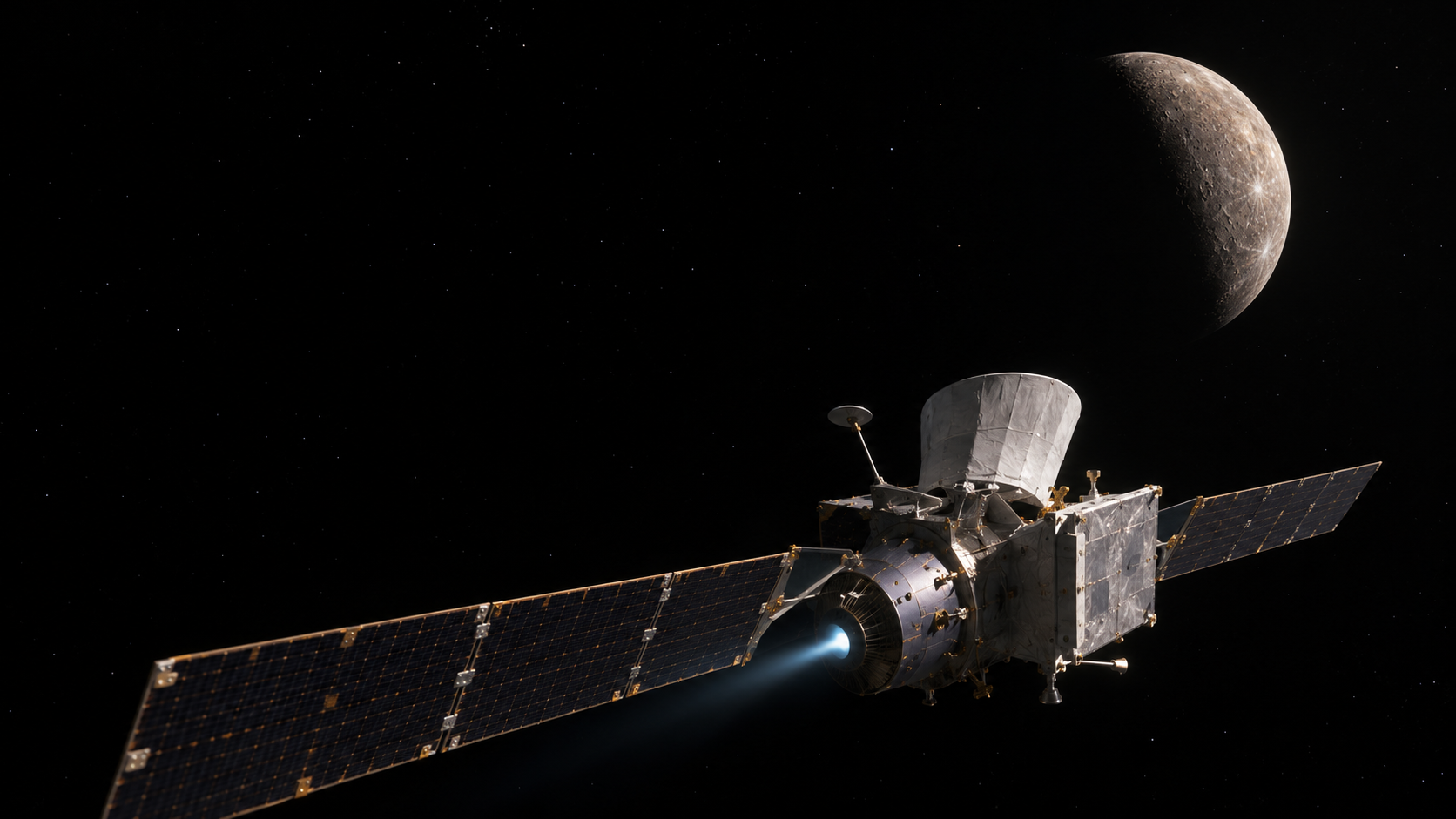
BepiColombo’s planned arrival at Mercury has been complicated by a reported thruster glitch, creating uncertainty around one of the mission’s most important milestones. SpaceNews described the problem as clouding the spacecraft’s arrival, while Gizmodo reported that BepiColombo reached Mercury but experienced a propulsion issue Source 1 Source 3.
The available reports do not identify the affected thruster, explain the technical cause, or confirm the long-term effect on the mission schedule. They also do not establish whether BepiColombo completed its final operational orbit insertion or merely reached the Mercury system.
That distinction matters. A spacecraft can reach a planet’s vicinity without completing every maneuver required for routine scientific operations. Updates from the European Space Agency (ESA), the Japan Aerospace Exploration Agency (JAXA), and mission controllers should clarify the spacecraft’s status.
What Is BepiColombo?
BepiColombo is a joint ESA and JAXA mission designed to study Mercury, the smallest planet in the Solar System and the one closest to the Sun. It uses two scientific spacecraft:
- ESA’s Mercury Planetary Orbiter.
- JAXA’s Mercury Magnetospheric Orbiter, also known as Mio.
Together, the orbiters are intended to examine Mercury’s surface, interior, magnetic field, exosphere, and surrounding magnetosphere. The mission aims to explain how a small rocky planet formed and evolved in an extreme environment.
Mercury has a disproportionately large metallic core, a global magnetic field, and a tenuous exosphere shaped by sunlight, solar wind, and surface processes. These characteristics make it an important comparison point for Earth, Venus, and Mars.
Why Mercury Is Difficult to Reach and Orbit
Mercury is a challenging destination despite its proximity to Earth. A spacecraft traveling toward the inner Solar System is strongly affected by the Sun’s gravity. Reaching Mercury and entering orbit requires the spacecraft to shed substantial orbital energy through a carefully designed trajectory.
The spacecraft must also operate close to the Sun, where sunlight and thermal loads are intense. Mission planners must balance trajectory requirements with thermal limits, power, communications, and instrument protection.
Propulsion is central to this process. Thrusters help control the spacecraft’s path and support precise maneuvers. A problem with a thruster or related propulsion system can affect the timing and execution of a planned maneuver.
A glitch does not automatically mean mission failure. Its significance depends on the affected hardware, the duration of the problem, the spacecraft’s trajectory, and the availability of backup systems or alternate procedures.
What the Reports Confirm
SpaceNews reported that a thruster glitch clouded BepiColombo’s planned arrival at Mercury Source 1. Gizmodo described the spacecraft as having reached Mercury but encountering a thruster glitch Source 3.
The Register separately reported that Japan’s space agency had announced an arrival date for BepiColombo, although the supplied summary does not include the date or technical details Source 9.
The wording may refer to different stages of the mission. “Reached Mercury” could describe arrival in the planet’s vicinity or completion of a major navigation milestone. “Arrival at Mercury” could refer to orbital insertion, establishment of the intended operational orbit, or the beginning of routine science activities.
The available reports do not resolve that distinction.
What Remains Unknown
The current reports do not specify:
- Which thruster or propulsion subsystem experienced the problem.
- Whether the glitch was temporary, intermittent, or permanent.
- Whether the spacecraft remains fully controllable.
- Whether the announced arrival date has changed.
- Whether BepiColombo entered its intended science orbit.
- Whether all required mission configuration steps are complete.
- Whether science operations will be delayed or reduced.
These questions require an official engineering assessment. ESA and JAXA mission teams would need to review telemetry, propulsion performance, trajectory data, and system redundancy before describing the problem’s consequences.
No available source establishes hardware damage, fuel loss, loss of control, or mission failure. Such claims would go beyond the reported information.
Why a Thruster Problem Can Affect the Timeline
Reaching Mercury’s vicinity is only one part of an arrival sequence. The spacecraft must perform carefully timed maneuvers to adjust its speed, shape its trajectory, and establish the intended orbit.
A propulsion anomaly can require controllers to pause the planned sequence. They may need to:
- Confirm communications and spacecraft orientation.
- Review propulsion-system telemetry.
- Determine whether the thruster can operate safely.
- Recalculate the trajectory.
- Delay or modify the next maneuver.
- Assess backup systems and alternate procedures.
Even a short interruption can affect later events if the mission depends on a precise sequence of burns. Controllers may choose a controlled delay rather than execute a maneuver while the propulsion status remains uncertain.
Operations near Mercury are demanding because the spacecraft must function in intense sunlight and high thermal conditions while maintaining communications and power. A delay may also require coordination with spacecraft attitude, thermal constraints, communications windows, and instrument readiness.
This does not mean that every delay becomes a major mission disruption. Complex spacecraft missions routinely include contingency planning. However, the specific response for BepiColombo cannot be confirmed from the available reports.
BepiColombo’s Scientific Goals
BepiColombo is designed to investigate Mercury’s geological history and internal structure. Orbital observations can help researchers study the planet’s surface composition, geological features, and evidence of past volcanic or tectonic activity.
The mission also aims to improve understanding of Mercury’s unusually large metallic core. Measurements of the surface and interior may help scientists test explanations for how Mercury formed close to the Sun and evolved under intense heating and bombardment.
Mercury’s global magnetic field makes it an important target for studies of planetary magnetism. BepiColombo is expected to examine how the field interacts with the solar wind and how the resulting magnetosphere changes in response to solar activity.
The mission may address questions about:
- The structure of Mercury’s magnetosphere.
- The interaction between the magnetic field and charged particles.
- The solar wind’s influence on the exosphere.
- The relationship between Mercury’s interior and magnetic field.
The two-orbiter design supports complementary measurements of Mercury’s surface, interior, magnetic environment, and surrounding particles. The results could improve models of the early Solar System and provide context for rocky planets orbiting other stars.
What the Glitch Could Mean
Several outcomes remain possible, but none is confirmed by the available reporting:
- A brief delay while engineers diagnose the problem.
- A revised maneuver schedule.
- Use of redundant propulsion or spacecraft systems.
- A change to the sequence of arrival activities.
- A longer review before orbital operations begin.
A propulsion issue can affect timing without ending the mission. If the spacecraft remains stable and controllable, controllers may be able to adapt the trajectory or change the order of operations.
An altered arrival plan could affect instrument commissioning, orbital configuration, coordination between the two spacecraft, and the start of routine science observations. The mission team may initially prioritize essential spacecraft operations and begin instrument commissioning only after confirming suitable orbit, power, communications, and thermal conditions.
A delay would not necessarily reduce the mission’s final scientific value. Space missions often adjust observation schedules to reflect changes in orbital timing and spacecraft availability. The impact depends on whether the glitch affects one maneuver or a broader propulsion capability.
Why Early Reports May Sound Contradictory
Space missions use several separate milestones:
- Reaching the Mercury system.
- Completing a trajectory maneuver.
- Entering an operational orbit.
- Configuring or separating mission components.
- Beginning instrument commissioning.
- Starting regular science operations.
One report may describe the spacecraft as having reached Mercury, while another focuses on uncertainty surrounding the planned arrival milestone. Both descriptions can refer to different stages of the same sequence.
The most reliable interpretation will come from official ESA and JAXA terminology once the agencies publish a detailed status update.
What Happens Next?
The expected sequence is:
- Mission teams assess the thruster anomaly.
- Controllers determine whether the spacecraft can continue on its planned trajectory.
- ESA and JAXA publish a technical status update.
- The agencies confirm or revise the arrival and orbital timeline.
- Instruments undergo commissioning before regular science operations begin.
The most important milestone will be confirmation of BepiColombo’s operational orbit. That information should clarify whether the glitch affected one maneuver or caused a broader change to the mission plan.
Further updates may also explain whether the spacecraft can use alternate propulsion options and whether the science schedule requires adjustment.
Conclusion
BepiColombo’s Mercury arrival has been complicated by a reported thruster glitch. SpaceNews described the planned arrival as uncertain, while Gizmodo reported that the spacecraft reached Mercury but encountered a propulsion problem Source 1 Source 3.
Propulsion is essential for reaching and orbiting Mercury, so the problem deserves close attention. However, the available information does not establish the anomaly’s severity, cause, or long-term effect.
The next official ESA or JAXA update should determine whether BepiColombo faces a short delay, a revised arrival plan, or a broader operational change.
Frequently Asked Questions
What happened to BepiColombo?
A thruster glitch was reported during the mission’s Mercury arrival phase. The available reports do not specify the technical cause or final mission impact.
Did BepiColombo successfully arrive at Mercury?
The source summaries use different descriptions. One report says the spacecraft reached Mercury, while another says the planned arrival was clouded by the glitch. A definitive answer requires clarification of whether “arrival” means reaching the Mercury system, completing orbital insertion, or beginning routine science operations.
What does BepiColombo study?
BepiColombo studies Mercury’s surface, interior, magnetic field, exosphere, and magnetosphere. The mission also investigates how Mercury formed and evolved near the Sun.
Why are thrusters important?
Thrusters help control the spacecraft’s trajectory and perform precise orbital maneuvers. A malfunction can require controllers to delay, revise, or recalculate a planned maneuver.
Has the mission failed?
The provided sources do not report mission failure. They report a propulsion problem and uncertainty surrounding the arrival. The mission’s status depends on official technical assessments and follow-up announcements.
When will science operations begin?
The supplied summaries do not establish a confirmed science-start date. Timing depends on the spacecraft’s orbital status, propulsion assessment, and instrument commissioning.
Related Articles
-
 How to See November’s Beaver Moon Supermoon
-
 Voyager 1 Faces New Data Glitch in Historic Mission
-
 Nature vs. Nurture: How Much Do Genes Matter?
-
 Voyager 1 Reaches a Reported One Light-Day From Earth
-
 17 Best Voyager 1 Photos and Why They Matter
-
 How the Brain Represents Meaning Across Languages
-
 Renewed Rifting Detected Beneath Southern Africa
-
 Stonehenge’s Altar Stone Came From Scotland, Not Wales
-
 Earth’s New Mini-Moon 2026 QQ8: How Long Will It Stay?
-
 How to Watch the 2025 Beaver Moon Supermoon
-
 Why Russia’s Routine ISS Resupply Mission Draws Attention
-
 BepiColombo Mercury Arrival Uncertain After Software Issue
-
 Possible Second Earth-Like World Beyond Neptune
-
 2,000+ Arthropod Species Found in North American Homes
-
 Rare Triple-Star System 28 Light-Years Away
-
 BepiColombo Has Not Yet Entered Mercury’s Orbit